
Unraveling the clinical conundrum of “Happy Hypoxia" , or, “Silent Hypoxemia”
July 2nd, 2020
By Kripa Krishnan
Labored breathing, otherwise known as dyspnea, is what usually prompts one to call an ambulance, go to the ER, or in some cases merely report suffering/illness to a medical practitioner and if this happens to be a manifestation of Covid-19, it is most likely to have serious implications.
The term ‘Happy Hypoxics’ has been given to those who are biologically deprived of oxygen but on a face level seem to be absolutely fine. In a way they are asymptomatic; a term that is no stranger to Covid-19. Evidently, a low saturation of oxygen isn’t always coupled with obvious respiratory difficulties (Frankel, 2020) and this article will walk you through why this may be the case.
Before diving into better understanding this phenomenon, it would be worthwhile to familiarize yourself with some concepts:
- Hypoxemia refers to the condition wherein the oxygen level in your blood is below the normal level. Anatomically, it refers to the blood flow through to the left ventricle without fully being oxygenated despite passing through the alveoli.
- Hypoxia refers to the condition resulting from inadequacy in the level of oxygen in tissue available for cellular metabolism
- SaO2 (Oxygen saturation) refers to the percentage of how much of the hemoglobin is saturated with oxygen. Normal levels range between 95% — 100%.
- PaCO2 is the partial pressure of Carbon Dioxide which is used to evaluate the CO2 levels in the blood.
- PaO2 is the partial pressure of oxygen in arterial blood or rather the actual pressure exerted on the container walls by oxygen
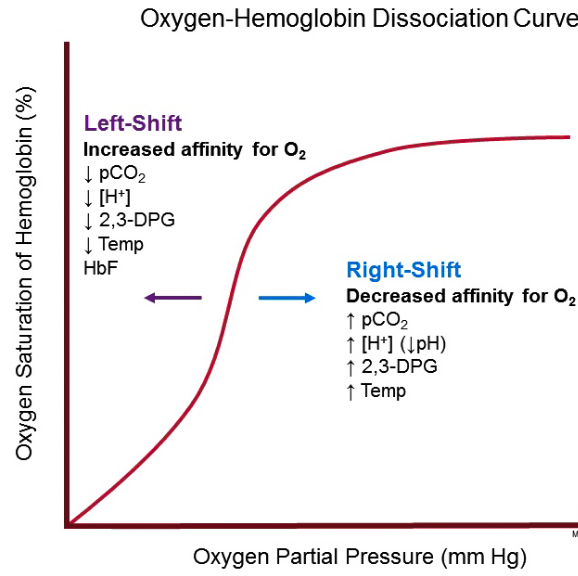
The oxyhemoglobin dissociation curve illustrates the relationship between oxygen saturation and the partial pressure of oxygen. The sigmoidal shape of the curve essentially demonstrates the underpinnings of the interactions between the hemoglobin and oxygen. Hemoglobin has four binding sites and its affinity to oxygen increases as more oxygen is bound. Thus, the oxygen saturation percentage tends to rapidly increase before reaching a plateau, which denotes saturation. Likewise, as the partial pressure of oxygen falls, after a certain threshold, there will be a rapid release of oxygen for tissue uptake.
There are a few reasons people with PaO2 below 60mmHG, or oxygen saturations below 90% may not display dyspnea:
(not exhaustive)
- Levels of PaCO2 — As Oxygen levels decline, the body induces rapid breathing as a means of compensation and as a result expels carbon dioxide. In some cases, the ventilatory and dyspnea responses are heavily influenced by the PacCO2 levels (Tobin MD, et al, 2020) and so if the individual is able to maintain safe levels of PaCO2, the body may not induce dyspnea.
- Shifts in the oxygen-dissociation curve — Fever, which is a prevalent symptom, can cause the whole curve to shift to the right (Tobin MD, et al, 2020). When this happens, at any given level of PaO2, there will be a lower level of oxygen saturation and since the carotid bodies, responsible for chemoreceptor stimulation which induces dyspnea, respond to mostly PaO2 levels, the individual may not experience dyspnea despite relatively low oxygen saturation levels.
- Lung compliance/elasticity — Perhaps, in some cases, individuals may have healthy lungs able to normally expand and contract to satisfy normal breathings requirements and so the need to gasp for air may be lower, or, even absent.
If we can anticipate, or rather, diagnose such cases prior to the onset of dyspnea and intervene we may be able to influence the trajectory and severity of the illness. Having said that, there is nothing set in stone that can predict the emergence of these asymptomatic hypoxic states and we’d have to infer based on other correlating symptoms. Here are symptoms in addition to the Covid-19 associated symptoms to look out for:
- Aggravated states of deliriousness/confusion/restlessness
- Sudden feeling of coldness
- Intense muscle aches coupled with fatigue
Pulse oximetry
A pulse oximeter is used to measure the peripheral oxygen saturation (SO2) in the blood as well as your pulse rate (heartbeats per minute). There has been a lot of advocacy and controversy around the use of oximeters. As such, it is imperative to take the following points into consideration prior to using an oximeter:
There are many external factors that can influence the reading:
- Physical movement
- Precision of device placement
- Low blood pressure
- Cold hands / poor circulation at the time of measurement
- There are intrinsic factors of the actual device that may also distort the reading and there aren’t too many studies that have validated the performances of the technology.
- Mere oxygen saturation rate may give a false sense of security
- Possible misinterpretation of results without proper guidance from a medical professional
References
https://science.sciencemag.org/content/368/6490/455 https://www.atsjournals.org/doi/pdf/10.1164/rccm.202006-2157CP
© 2020 Coronavirus Visualization Team